


Blog
5×112 vs 5×4.5: Trailer Hub Bolt Pattern Guide

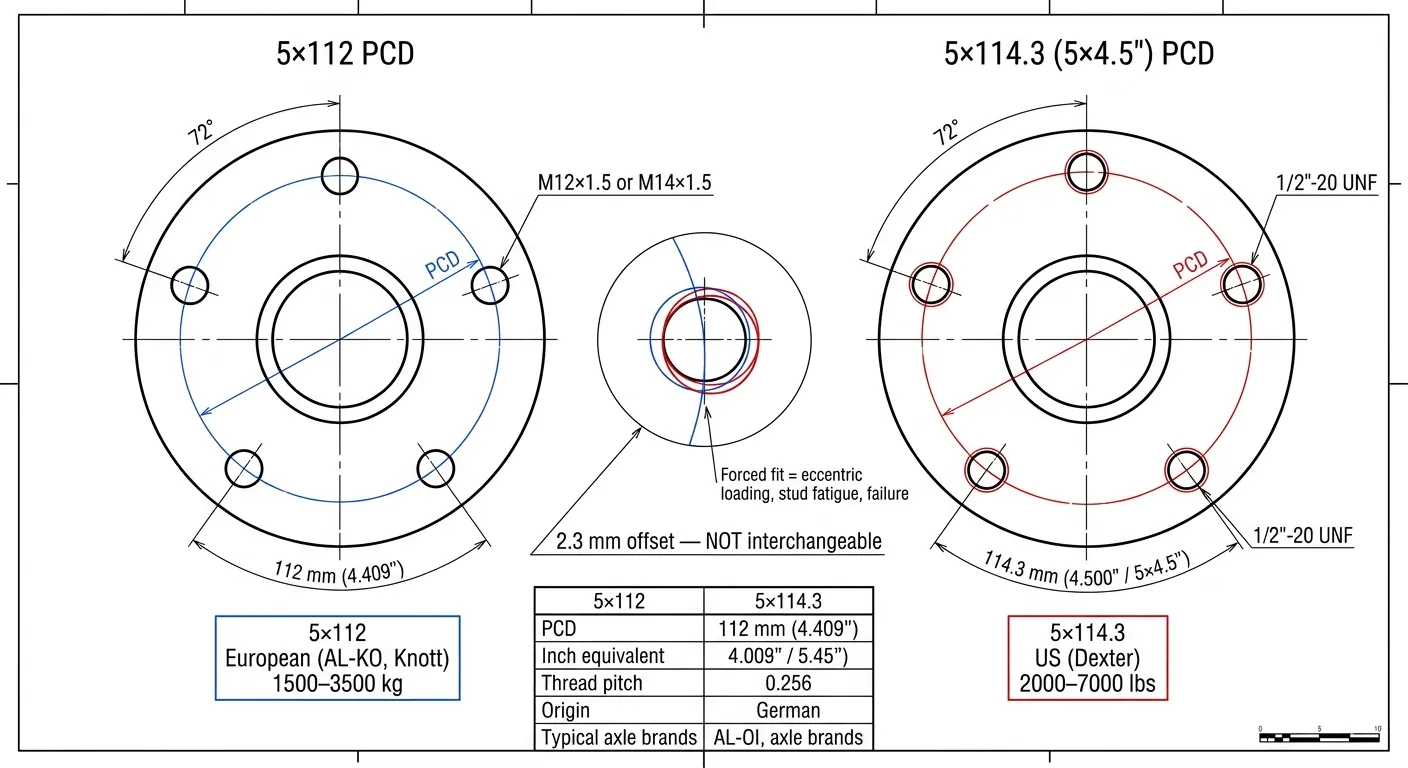
Understanding PCD, thread pitch, and why 2.3 mm of difference matters more than you think.
If you have ever swapped wheels between trailers and wondered why one set vibrates at highway speed while another runs dead smooth, the answer is almost certainly the bolt pattern — specifically the PCD. Two of the most common five-bolt patterns in the trailer industry, 5×112 and 5×4.5, look nearly identical to the naked eye. But they are not interchangeable, and forcing a fit is a shortcut to damaged studs, wheel failure, or worse.
At MrLiuAxle, we machine trailer hubs in both patterns for OEM builders and aftermarket replacement. If you are trying to match a hub to an axle or a wheel to a hub, ourcovers both European and US standards.hubs and brake drums catalog
What Is PCD?
PCD stands for Pitch Circle Diameter. It is the diameter of an imaginary circle drawn through the center of each wheel bolt hole. For a five-bolt pattern, you cannot measure PCD directly with a ruler across two holes — the geometry does not line up. Instead, measure the center-to-center distance between two adjacent bolt holes and multiply by 1.7012. Or use a PCD gauge.
The critical point: PCD is not a tolerance range. It is a hard specification. A 5×112 hub expects bolt holes on a 112 mm circle, full stop. A 5×4.5 hub expects them on a 114.3 mm (4.5 inch) circle. The difference is only 2.3 mm, but that is enough to throw the wheel off-center and load the wheel studs in bending rather than pure tension.
5×112: The European Standard
PCD:112 mm (4.409″)
Stud thread:M12×1.5 or M14×1.5 (metric)
Common on:AL-KO, Knott, BPW, and most European OEM hubs
Typical capacity:1,500–3,500 kg per axle
Markets:Europe, Russia, Belarus, Kazakhstan, Turkey
5×112 is the dominant pattern in Europe and the EAEU. If you are building trailers for Germany, France, Russia, or the CIS states, this is the pattern your customers expect. Both AL-KO and Knott manufacture their standard hub lines around this PCD, and it pairs naturally with their drum brake systems (2051, 2361, and KFG series).
5×4.5″ (5×114.3): The US Standard
PCD:114.3 mm (4.500″)
Stud thread:1/2″-20 UNF (imperial)
Common on:Dexter, Lippert, and most US-built trailer axles
Typical capacity:2,000–7,000 lbs per axle
Markets:USA, Canada, Australia, Mexico, Southeast Asia
5×4.5″ is the North American standard. Dexter Axle uses it across their 2,000–7,000 lbs product lines, and it has been adopted in Australia and parts of Asia as well. The thread pitch is imperial (1/2″–20 UNF), which adds another layer of incompatibility with European hubs even before you get to the PCD issue.
Why 2.3 mm Matters More Than You Think
Here is what happens when you mount a 5×112 wheel on a 5×4.5 hub (or vice versa): the bolt holes do not align perfectly. The nuts will start by hand, which makes the fit feel “close enough.” But under torque, each stud sits at a slight angle to the wheel plane. The wheel centers eccentrically — meaning it rotates off-center.
At highway speed, this creates a harmonic vibration that wheel balancing cannot fix because the wheel itself is running out of round relative to the hub. More critically, the studs are loaded in shear and bending rather than pure tension. Over time — usually a few hundred kilometers — the fatigue causes the stud threads to strip or the stud body to shear entirely. I have seen hubs come into the shop with three of five studs snapped clean off. The owner always says the same thing: it felt fine when I tightened it up.
Rule of thumb: if the wheel does not slide onto the hub and seat flush by hand without any bolt engagement, stop. Something is wrong — PCD, center bore, or both.
I posted a visual breakdown of these two patterns on LinkedIn with a CAD-style overlay showing exactly where the 2.3 mm offset sits. If you are more of a visual learner,.check it out here
Quick Reference: Which Pattern Do You Need?
Building for Europe / Russia / EAEU / Turkey→ 5×112
Building for USA / Canada / Australia / Mexico→ 5×4.5″
Exporting globally or unsure→ dual-PCD hubs are available by request
Need both on one axle line→ specify at order; we machine both patterns from the same hub blank
The stud thread is the other half of the equation. A 5×112 hub uses metric studs (M12 or M14). A 5×4.5″ hub uses imperial (1/2″–20 UNF). Even if you somehow matched the PCD, the thread pitch mismatch would stop you. Always verify both PCD and thread size before ordering wheels or hubs.
Final Thoughts
Bolt pattern mismatches are one of the most avoidable failures in trailer building. The 5×112 vs 5×4.5″ confusion persists because the two patterns look so similar and because many builders assume close enough is good enough. It is not. Measure twice, order once, and always confirm the PCD and thread pitch as a matched pair.
We stockin both 5×112 and 5×4.5″ patterns, compatible with Knott and AL-KO brake systems, with full ECE R13/E24 certification. If you need help matching the right hub to your axle and wheel combination, contact our engineering team — we are here to help you build trailers that last.galvanized trailer hubs