


Blog
How to Choose Trailer Axle Load Capacity: A Complete Technical Guide

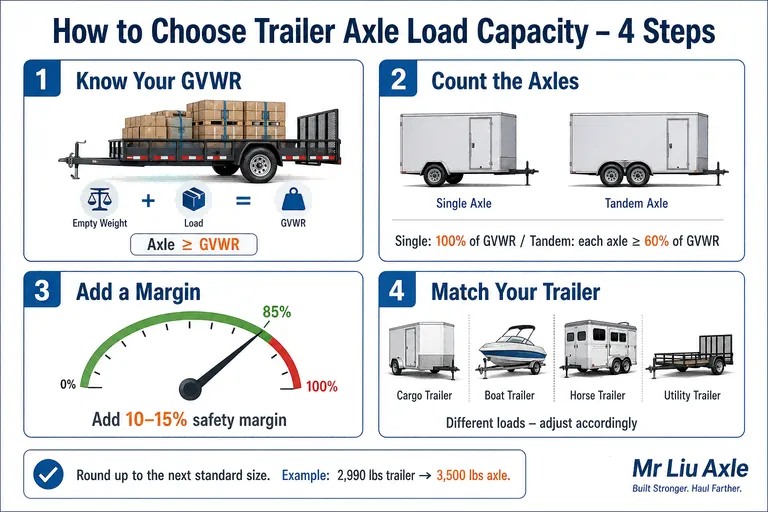
Selecting the correct trailer axle load capacity is one of the most critical decisions in trailer design and maintenance. Get it wrong, and you risk component failure, unsafe towing conditions, and costly roadside repairs. Get it right, and your trailer will deliver reliable performance for years. At MrLiuAxle.com, we manufacture a full range of trailer axles, brake systems, and suspension kits. This guide distills what we have learned from years of production and field feedback into four actionable steps.MrLiuAxle.com
Step 1 — Get Your GVWR Right
Gross Vehicle Weight Rating (GVWR) is the foundation of every axle specification. It is defined as:
Trailer weight + maximum cargo = GVWR
Your axle capacity must be greater than or equal to the GVWR. There is no compromise here. Underspecifying the axle to save cost is a false economy — it leads to premature bearing wear, spindle fatigue, and in extreme cases, catastrophic failure under load.
If you need help calculating GVWR for your specific build, explore ourto find rated capacities that match your requirements.trailer axle product range
Step 2 — Count Your Axles
Axle count changes the load distribution math dramatically:
Single axle:One axle carries the entire GVWR. Capacity = GVWR.
Tandem axle:Each axle should be rated for at least 60% of the GVWR. This accounts for uneven loading, road irregularities, and dynamic weight shift during braking and cornering.
For example, a 7,000 lbs GVWR trailer with tandem axles should use two axles rated at 4,200 lbs or higher — not 3,500 lbs each. That 60% rule is what keeps trailers safe when the cargo shifts or the road gets rough.
Step 3 — Add a Safety Margin
Never run an axle at 100% of its rated capacity. In real-world operation, trailers encounter potholes, emergency braking, off-center loading, and temperature extremes. A safety margin absorbs these variables.
Our engineering recommendation: add 10–15% extra capacity above your calculated requirement. This modest margin extends bearing life, reduces spindle stress, and prevents the heat buildup that leads to premature seal failure. It also gives you flexibility if your cargo needs change slightly in the future.
Think of it as cheap insurance. A 3,500 lbs axle working at 3,200 lbs will outlast the same axle running at 3,450 lbs — and it will run cooler, quieter, and safer.
Step 4 — Match Your Trailer Type
Not all trailers load the same way. Axle selection must reflect the application:
Cargo trailers:Concentrated, dense loads near the front. Axles need higher static ratings.
Boat trailers:Dynamic water loading, launch ramp angles, and saltwater corrosion risk. Galvanized or aluminum axles with sealed bearings are standard.
Horse trailers:Live load movement. Smooth suspension and generous safety margins are essential for animal safety.
Utility trailers:Mixed, unpredictable loads. Versatility matters — choose a rating that covers your heaviest anticipated cargo.
Browse application-specific solutions onto match your trailer category with the right axle, brake, and suspension combination.MrLiuAxle.com
Special Rule for Light Trailers (< 8,000 lbs GVWR)
For lighter trailers, we recommend rounding up to the next standard axle size. A trailer with a calculated requirement of 2,990 lbs should use a 3,500 lbs axle, not a 2,500 lbs or 3,000 lbs unit.
Why? Standard axle sizes are priced competitively, and the small cost difference between a 3,000 lbs and 3,500 lbs axle is negligible compared to the cost of a roadside failure. Rounding up also simplifies future upgrades — if your cargo needs grow, your axle is already ready.
Practical example: A 2,990 lbs utility trailer gets a 3,500 lbs axle. That extra 510 lbs of capacity costs little upfront and pays for itself in durability, reliability, and peace of mind.
Summary Checklist
- GVWR = trailer weight + max cargo. Axle capacity >= GVWR.
- Single axle = 100% GVWR. Tandem = each axle >= 60% GVWR.
- Add 10–15% safety margin for real-world conditions.
- Adjust for trailer type: cargo, boat, horse, utility.
- Light trailers (< 8,000 lbs): round up to the next standard axle size.
| Follow MrLiuAxle on LinkedIn Get regular technical insights, production videos, and industry updates.
|
For axle specifications, brake kits, suspension components, and custom trailer solutions, visit
or contact our engineering team directly. We are here to help you build trailers that last.www.mrliuaxle.com
Published by MrLiuAxle — expert manufacturer of trailer axles, brake systems, and suspension components.