


Blog
Forged vs. Stamped + Welded Torsion Arms – What Every Trailer Manufacturer Should Know

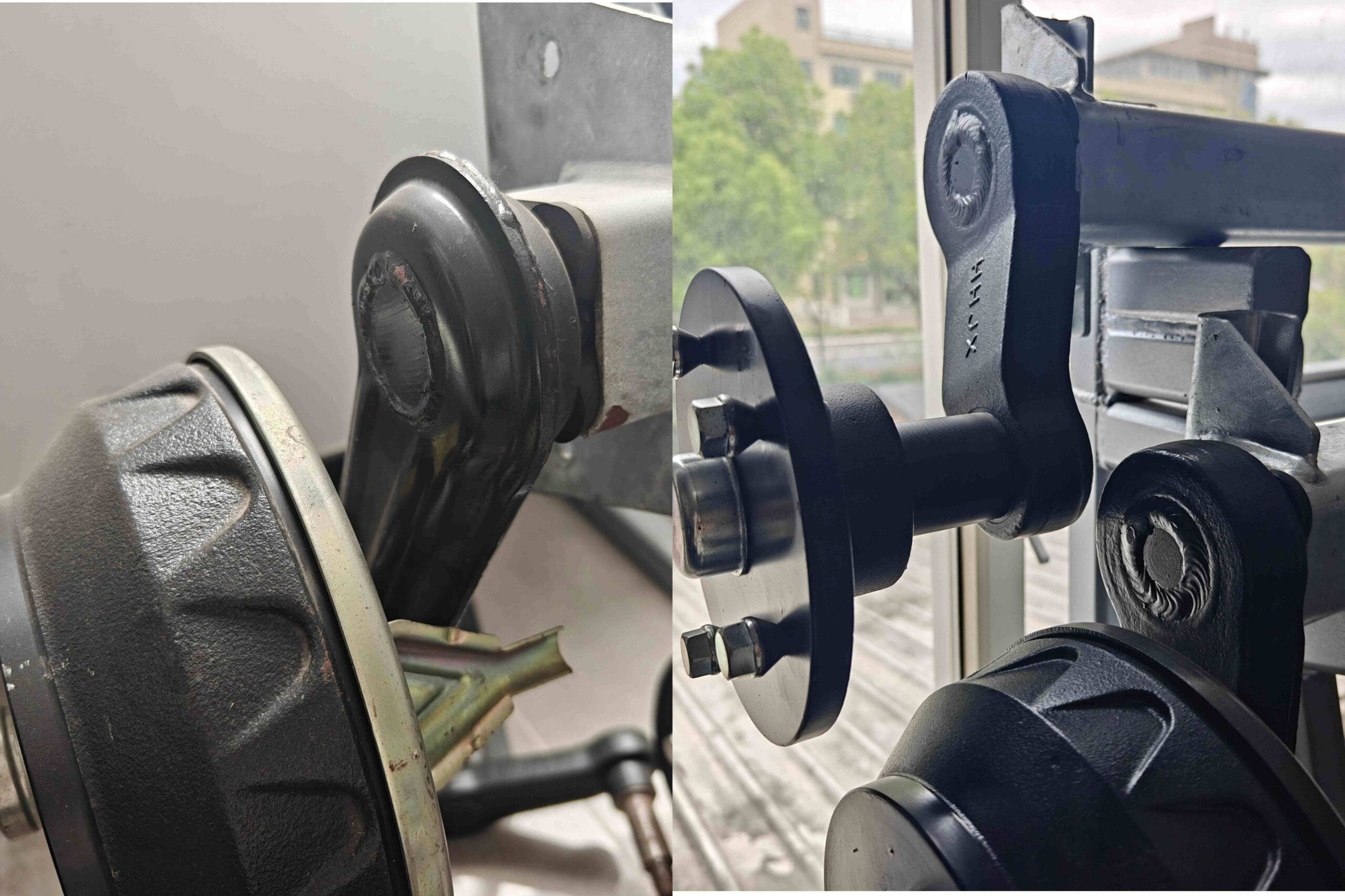
When you’re building trailers for a living, every component matters. But few parts take as much abuse as the torsion arm on a torsion axle.
Over the years, I’ve seen both designs fail. I’ve also seen both last. The difference comes down to how the arm is made – forged, or stamped and welded.
Here’s what 20 years in the workshop taught me.
What’s a Torsion Arm Anyway?
The torsion arm is the part that connects the wheel hub to the rubber-cord core inside the axle tube. It transfers every bump, pothole, and load from the road directly into the suspension.
If the arm bends, cracks, or twists, the whole axle fails. That’s why the way it’s manufactured isn’t just a detail – it’s the backbone of your trailer’s reliability.
Stamped + Welded – The Low-Cost Option
Many manufacturers choose stamped and welded arms because they’re cheaper to produce. Two pieces of steel are stamped into shape, then welded together.
The downsides:
- Welds create weak points – Under heavy or repeated loads, the heat-affected zone around the weld can crack.
- Lower strength-to-weight ratio – The arm is lighter, but not in a good way. It’s simply less material.
- Prone to bending – Without a continuous grain structure, the arm can twist or deform over time.
- Inconsistent quality – Weld penetration and alignment vary from batch to batch.
For light-duty, occasional use, a stamped + welded arm might survive. But for commercial trailers, off-road caravans, or heavy loads, it’s a gamble.
Forged – One Piece, No Compromises
Forging takes a solid billet of steel, heats it until it’s malleable, then presses it into shape under enormous pressure. The result is a single, seamless piece of metal.
Why forging wins:
- No welds, no weak spots – The arm is one continuous structure. Nothing to crack.
- Grain structure flows with the shape – Unlike stamped metal where grains are cut, forging aligns the grain along the contours of the arm. This makes it naturally stronger.
- Superior shock absorption – Forged arms handle sudden impacts (think a pothole at highway speed) without fracturing.
- Longer service life – In real-world use, a forged arm often outlasts a stamped + welded arm by years, not months.
Yes, forging costs more to produce. But the upfront difference is small compared to the cost of a roadside axle failure.
For a deeper technical dive into how forging creates superior grain structure compared to casting and stamping, see GL Forge: Forging vs. Casting – The Metallurgical Advantage.
Real-World Comparison
Real‑World Comparison
| Property | Stamped + Welded | Forged |
|---|---|---|
| Manufacturing cost | Lower | Higher |
| Weld points | Yes (weakness) | None |
| Grain structure | Interrupted | Continuous |
| Impact resistance | Moderate | High |
| Risk of bending/twisting | Higher | Very low |
| Typical service life (heavy use) | 1–3 years | 5–10+ years |
Does Higher Volume Change the Math?
For manufacturers producing thousands of axles, the cost difference between stamped + welded and forged becomes smaller per unit. Tooling and setup costs for forging are higher upfront, but they amortize over large batches.
That means the “forged is too expensive” argument only holds true for very small runs. Once you scale up, forging becomes not just the stronger choice – but also a surprisingly economical one.
My Take After Two Decades
I’ve repaired both types. I’ve seen cracked welds on trailers that were barely two years old. I’ve also pulled forged arms from axles that had been on the road for a decade – still straight, still solid.
If you’re building a trailer that will carry anything valuable (or anything you care about), choose forged.
It’s not about over-engineering. It’s about building something that lasts.
Every torsion axle and independent suspension kit we ship uses forged torsion arms. Browse our torsion axle range, spring axles, or matching brake drums and hub assemblies – all built with the same no-shortcuts philosophy.
Questions about forged arms for your build? Contact us and I’ll give you a straight answer.
Mr Liu
20 years making axles. No shortcuts.