


Blog
Trailer Wheel & Tire Sizing: Matching 13″, 14″, and 15″ Rims to Your Axle Hub

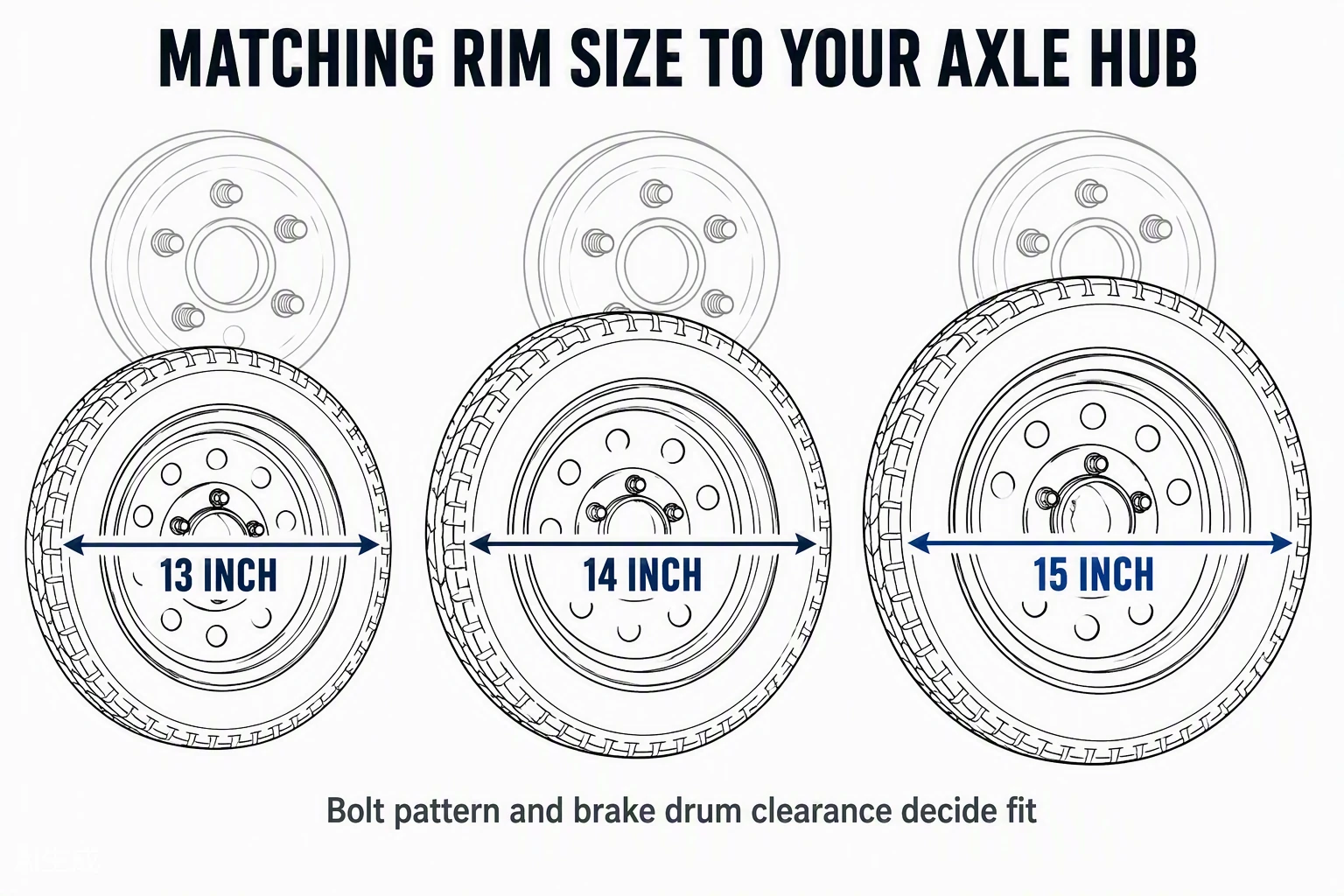
Trailer Wheel & Tire Sizing: Matching 13″, 14″, and 15″ Rims to Your Axle Hub
A customer once sent us a photo of a brand-new 15-inch rim leaning against his trailer, with a short message: “It doesn’t fit. Why?” The rim was fine. The hub was fine. The problem was that he had ordered by tire size alone — and never checked the bolt pattern stamped on his hub. It is one of the most common mistakes we see, and it is completely avoidable. Rim size, bolt pattern, pilot bore, and load range all have to agree with your axle hub before a wheel ever touches the trailer.
How do I know what rim fits my trailer axle hub?
Start with the hub, not the tire — the hub decides everything. Three measurements control fitment:
1. Bolt pattern (lug pattern). Count the studs and measure the bolt circle diameter. A 4-lug hub on a light utility axle is usually 4 on 4″. The most common pattern on 3,500 lb axles is 5 on 4.5″. Heavier 5,200–7,000 lb hubs move to 6 on 5.5″ or 8 on 6.5″. If the bolt circle doesn’t match, the rim will not fit — and “close enough” is how studs shear off at highway speed.
2. Pilot bore (center hole). Trailer wheels are hub-centric: the rim’s center bore pilots on the hub’s center register, carrying the load while the lugs simply clamp. A bore even a few millimeters too small won’t seat; too large, and the wheel rides on the studs alone — a job they were never designed to do.
3. Stud size and lug seat. Most 3,500 lb hubs use 1/2″-20 studs with 60° conical-seat lug nuts. Mixing conical and flange seats, or reusing worn nuts, leaves the wheel clamped at a fraction of its rated torque.
What rim sizes fit common trailer axle ratings?
The industry has settled into a predictable pattern. Use this table as a starting point, then confirm against your actual hub:
| Rim Diameter | Typical Axle Rating | Common Bolt Pattern | Common ST Tire Size | Typical Load Range |
|---|---|---|---|---|
| 13″ | 2,000–2,200 lb | 4 on 4″ / 5 on 4.5″ | ST175/80R13 | C / D |
| 14″ | 2,200–3,500 lb | 5 on 4.5″ | ST205/75R14, ST215/75R14 | C / D |
| 15″ | 3,500–5,200 lb | 5 on 4.5″ / 6 on 5.5″ | ST205/75R15, ST225/75R15 | D / E |
Notice the overlap: a 3,500 lb axle can wear 13″, 14″, or 15″ wheels depending on its hub. That is why “what rim fits a 3,500 lb axle?” has no single answer — the hub, not the axle rating, makes the call.
How do you read an ST trailer tire size?
An ST tire code reads in ten seconds. Take ST205/75R15:
- ST — Special Trailer. Stiffer sidewalls and higher load capacity than a passenger (P) tire of the same size. Never substitute a P-metric tire on a trailer axle.
- 205 — Section width in millimeters.
- 75 — Aspect ratio: sidewall height is 75% of the width.
- R15 — Radial construction, 15-inch rim.
Moving from ST175/80R13 to ST205/75R14 buys load capacity and a slightly larger rolling diameter. Stepping up again to ST225/75R15 Load Range E is the classic upgrade for tandem 3,500 lb setups that run heavy — just confirm fender and frame clearance at full suspension compression.
What load range do my trailer tires need?
Load range (C, D, E) is the tire’s ply-rated strength, and it is the number most people skip. A safe rule of thumb: the combined capacity of all tires should exceed the axle rating by at least 10–15%. Heat kills trailer tires, and heat comes from running at the ragged edge of capacity — four Load Range C tires on a tandem trailer may be legal on paper and still chronically overloaded if you tow at GVWR every weekend.
In Our Workshop
After 20 years of building axles, we can usually tell a mismatched wheel before the trailer stops rolling. The witness marks are unmistakable: elongated lug holes, galling around the pilot bore, studs with stretched threads. Almost every time, the story is the same — someone bought rims by diameter and hoped the rest would sort itself out.
That is why every hub we ship leaves with its bolt pattern, pilot bore, and stud spec on the tag. When a customer writes to ask “will your 5 on 4.5 hub take my 14-inch rims?”, we can answer in one email instead of after a return shipment. If you are speccing a new axle or swapping hubs, our trailer hub range lists bolt patterns and bores for every unit — match those numbers to your rim and the job is done before it starts.
Frequently asked questions
What size rim fits a 3,500 lb trailer axle?
It depends on the hub. Most 3,500 lb axles carry 5 on 4.5″ hubs that accept 13″, 14″, or 15″ rims — the bolt pattern and pilot bore decide fitment, not the axle rating.
Can I go from 13-inch to 15-inch rims on my trailer?
Usually yes, if the bolt pattern and pilot bore match and you have fender clearance for the taller tire. The common upgrade path is ST175/80R13 to ST205/75R15, which adds load capacity and a slightly larger rolling diameter.
Is a passenger (P) tire ever acceptable on a trailer?
No. ST (Special Trailer) tires have stiffer sidewalls built for high vertical loads and sway resistance. A P-metric tire of the same size carries less and runs hotter on a trailer axle.
How tight should trailer lug nuts be?
For the common 1/2″-20 studs, torque to 90–120 ft-lb in a star pattern, then re-torque after the first 50 miles. New wheels and freshly seated hubs settle, and the first re-torque is the one that prevents loose wheels.
For factory engineering data on hub and wheel combinations, the Dexter Axle literature library publishes torque charts and fitment tables worth keeping on file.
Not Sure Which Hub Your Axle Has?
Send us a photo of your hub face and a tape-measure reading across the studs. We will identify the bolt pattern, pilot bore, and the rim sizes that fit — usually within one working day. Browse our trailer hubs or contact the workshop directly.